


 Apple Podcasts
 Spotify
 Amazon Music
 iHeartRadio
 Ep 25 The Disadvantage of Medicare Advantage
Date: 7/22/24
Name of podcast: Dr. Patient
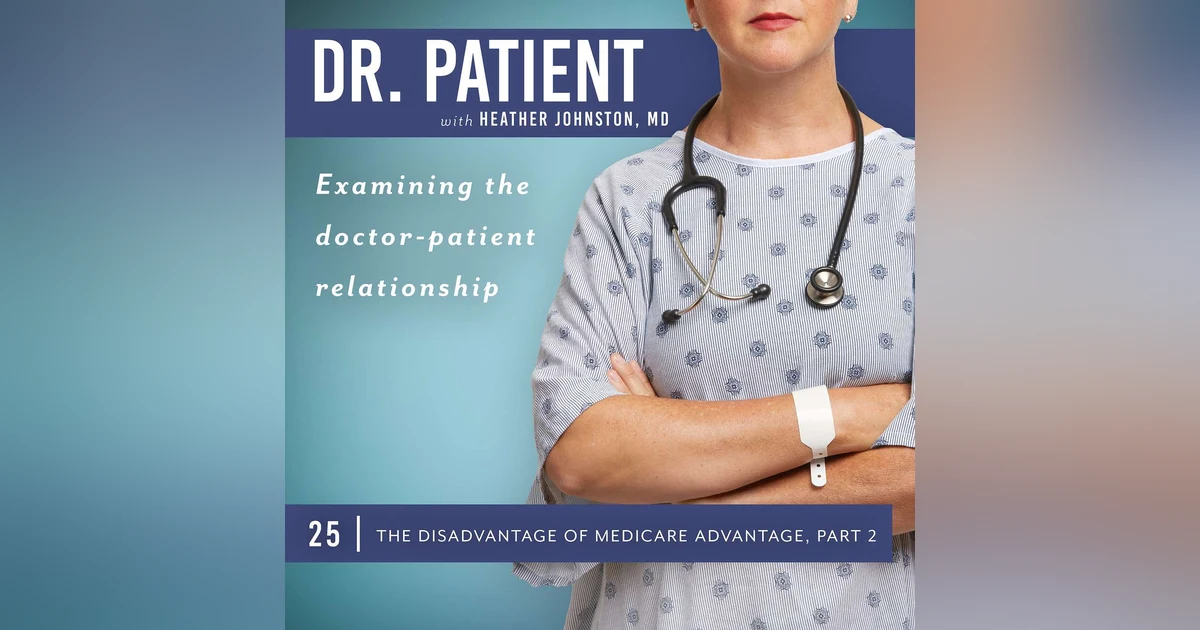
Episode title and number: 25 The Disadvantage of Medicare Advantage, Part 2
Episode summary: Part 2 discussing why Medicare Advantage plans are an actual DISadvantage for you and for our country's fiscal system. When you sign up for Medicare, you have a choice of Traditional/Original, Medicare or "Medicare Advantage", which is technically not Medicare and is instead a private health insurance company caring for you on their behalf, like a surrogate. The plans are Uber-restrictive and filled with hidden costs that many people don't recognize until it's too late. They often offer "zero dollar premiums" to lure folks in, then you might have trouble getting back into regular Medicare. Join Alexandra "Al" Eidenberg from The Insurance People, and me to hear all of the details.
Guest(s): Alexandra (Al) Eidenberg, President and Founder of The Insurance People
Key Terms: none
References:
The Insurance People homepage: www.theinsurancepeople.com
How to sign up for Medicare: https://www.medicare.gov/basics/get-started-with-medicare/sign-up/how-do-i-sign-up-for-medicare
This is Doctor Patient, a podcast that examines all the aspects of the patient-provider relationship. I'm your host, Heather Johnston, MD, a real-life doctor and patient. Hi everyone. Today I'll be continuing to talk about Medicare Advantage, which is part C of Medicare, in which you can elect to have health insurance coverage from a private health insurance company instead of going with what's called original or traditional Medicare. Last week in part one, I described how Medicare Advantage works behind the scenes and how it's a disadvantage to the country's fiscal system because the private insurers that sign up to offer it are consistently overpaid year after year. Today I'm pivoting to talk about why I also believe Medicare Advantage is a disadvantage for those who sign up for the plans. But I'm not alone today. I'm joined by Alexandra, or Al, as she likes to be called, Eidenberg, the founder and president of the Insurance People, an all-female-run insurance brokerage company here where I live in Illinois. The Insurance People has been recognized as one of the nation's fastest growing agencies by Insurance Business America, a top 10 small group agency by Insurance Business Review, and a top 15% national marketplace leader by CMS, that Center for Medicare and Medicaid services I talked about last week. She's a wife and mom of four children who loves spending hours on soccer fields, happily coaching and cheering on her kids' teams. When she isn't coordinating insurance or coaching soccer, Alexandra spends time walking, cooking, and traveling.
SPEAKER_00Alexandra Eidenberg, welcome to the show. I'm so excited to be here with you today, Heather.
SPEAKER_01Thanks for having me. Great. I've already given a little bit of background on how Medicare works in general. So let's dive in and I'd like to hear how you approach signing up for Medicare with a client that's around 65.
SPEAKER_00So Medicare is always a really daunting time for folks. You go from having one insurance policy for many years, often in the same career for 30 plus years, to suddenly needing multiple policies to equal one policy. I think generally speaking, retirement is often a very stressful time for people, many moving parts. And one of them is just the health insurance around it. And so on a day-to-day basis, we work hands-on with folks that are looking at that transition, coming up to 65. And the real crux of it starts three months prior to your birthday month. And that's when we begin to trigger what's called original Medicare, which is parts A and B. And I'm sure that many of your listeners know about parts A and B. But as a little bit of a refresher, part A is hospital coverage, part B is doctor coverage. Together, this is original Medicare that you get from the government, and it's part of the Social Security Medicare package in the United States.
SPEAKER_01Yeah. So what do you think the most confusing part is for people when they're just getting ready to sign up for Medicare?
SPEAKER_00Folks are often used to an employer picking all their options. You go through an annual, you know, checkup, you get to see what's going on, you go in your portal, you pick your options, it's done. Most employers present their folks with two, three options to pick from, and you just click and you're done and you're good to go. And you're used to a system of insurance that has deductibles and coinsurance and co-pays and networks. Fast forward, you go to Medicare, suddenly you're getting a portion from the government, a portion from private carrier, you're suddenly singing the alphabet in order to get one policy together. You need all of these letter components. It's a lot of moving parts. And especially during a time when you're already doing a big transition, which is often leaving a career you've been with for a long time.
SPEAKER_01Yeah, I never actually thought of it that way, but it's true. I mean, if you're lucky enough to have employer-based health insurance, you someone else has been doing this for you. I happen to actually do the insurance for my husband's small business. So I have been suffering through this for years already. So I feel sorry for everyone that has to come and do this on their own then later. So um so as I've talked about, people do have a choice when they're signing up for Medicare between original Medicare or what's called Medicare Advantage. Um, I've heard really mixed reviews about Medicare Advantage. Actually, it's not so mixed, it's more towards the negative, although most of my reviews I'm reading are have to do with like the finances and politics of it. What's your take on Medicare Advantage for clients who have signed up for that? Are they happy with it, not happy with it?
SPEAKER_00So I have over 700 Medicare clients, and zero of them are on an advantage plan. And that's because I refer to those as disadvantaged plans. As we transition over to Medicare for folks, again, you get that chassis of the insurance A and B. And once you get A and B, you have a decision. You can go either with an advantage plan, which is basically you giving away your benefits to a for-profit company, an insurance company to manage your health care. Those are going to be MCO model, managed care organization models, where you're you're letting a blue crossbow shield, an Aetna, uh whatever carrier it is, control your health care. Conversely, you can keep this base chassis of coverage, and then from there add on supplements. The supplements are really quite affordable, you know, $100, $150 a month range. And with that, you can go wherever, whenever. And then A and B, the government, pays first, and then that remainder gets paid by your supplement. It is some of the most comprehensive insurance you could ever have by getting A and B from the government alongside your supplement. And so for my clientele, they're not chasing the least expensive option. They want high quality health care in their retirement. They know that this is something they want to invest in. They know the older you get, the more likely you are to have health concerns, and they want something high quality. They don't want to lose network, they don't want to lose access. When you do an advantage plan, now, mind you, there's HMOs and PPOs and all sorts of stuff. However, it's all limited. That corporation can say, we're not covering these scans. You're not allowed to do physical therapy, you have to stay within this network. They have full control. Whereas on the other side, with A and B, the government's been dictating what's covered for years for us. You're under 65 group market, individual market, all of that's dictated by our government and what's the normal quality of care. So, same thing in the over 65 market. The government dictates what's covered. If it's covered, they paid their percentage, whatever the remainder is your supplement pays. So that transition into a supplement is so much easier for folks because they just know they're going to get what they need. And so if you're going to get to the holy land of insurance and make it to this Medicare age, why give it away to a corporation? That's how I see it and how my clients see it as well. And I think depending on the state you're from, sometimes MCOs do well, but they've never taken ground here in Illinois and they're just not super functional.
SPEAKER_01So you insinuated when you're talking, I hope I heard this correctly, but I think you insinuated that Medicare Advantage plans might be cheaper or lower quality.
SPEAKER_00Do you think that? I refer to them as disadvantaged plans. So I'm not insinuating. I am saying I think that they're a lesser opportunity. And so they can be flipped at times. I think the same way. I just need to ask not to be overly direct with you, Heather. But yes, I think that's a good idea.
SPEAKER_01No, I'm an overly direct person. I just have to feel people out. Great.
SPEAKER_00For sure. So I do think it's an inferior product. There's a reason why, out of all of these hundreds of people that I've helped where I'm talking about the difference between the plans, not one of them has gone that path. And I will say that if they do want an advantage plan, which has happened twice in my career, I've sent them to another agent. I'm not willing to service and broker a product that I don't trust and respect. And so if I sign somebody up for a product and they have a problem, it's my job to do that customer service. Most of the time, I'm the receiver of a call with somebody being like, I'm on an advantage plan. I had a stroke. I'm struggling walking. I have a speech impediment. I can't get my services. They won't give me speech therapy. They won't give me physical therapy. I probably wouldn't have had the stroke had they done the scan I needed originally prior to the stroke. And so I get to hear the calls where people are stuck on an advantage plan. And the problem is, is one, there's only certain enrollment periods.
SPEAKER_01Wait, so uh so let's uh I'm just gonna back you up there and just say, let's list the actual literal disadvantages of the Medicare Advantage plans as you see it.
SPEAKER_00So I think the biggest thing is one, you're limited to a certain network. Two, you're limited to what this corporation thinks they should cover that has no connection to medical decisions.
SPEAKER_02Okay.
SPEAKER_00Three, you have a lot of out-of-packet costs. So even if your plan is a zero dollar premium, you still have deductibles and co-pays and usage fees. And again, even if you can afford the deductibles and co-pays, this company can just say we're not covering it. And they're totally within their right to not cover scans, therapy, whatever they don't want to, because they have no guidelines of which they have to follow any longer. What I will note though, if you want to hear something good about an advantage plan, become an amazing series of coupons. So if you really like coupons like gym memberships and getting your toenails slipped for complimentary or getting Pilates classes, your advantage plan will cover those things. And so it has an array of coupons and discount programs, but then when the rubber meets the road, they're not really there for you. But if you need a good gym membership, it's a great method of getting one.
SPEAKER_01That's so weird and fascinating. Um, it seems like there's easier ways to get a gym membership and to get your toenails clipped and than like signing up with a terrible meta.
SPEAKER_00And I really encourage people to not go down the bunny hole of the coupons. As you get closer to 65, and especially in the six months part, or turning 65, your mailbox turns red, white, and blue. You are getting tons of advertisements. And a lot of these advertisements are trying to hook you into an advantage plan because what you once you sign up, you're very stuck. And they get you with the coupons. They get you with the, oh, you get a lifetime fitness membership, or you're gonna get uh paddle ball racket, you know, membership. They get you with the memberships, and then when it's a zero-dollar premium and it says that's a PPO, people get really into it, but they're not realizing what they're signing up for and what that trade-off is.
SPEAKER_01So I know that I've read that there are restrictions on what uh advantage plans are allowed and not allowed to do. I'm actually looking at my notes really quickly and I don't see it here quickly, but I know one of them is that they are not allowed to solicit uh a client or potential patient directly unless the patient is asked to be called by them. Are they allowed to email? Is that legally?
SPEAKER_00They cannot call like a literal phone call. That's not allowed. You would have to agree to being called. However, advertisements that all those things that come in the mail, that's totally fair game. And particularly generationally, people respond to mail differently. But this particular generation, especially not the boomer generation as much as the older generation from there, but like 85, 90-year-olds, they respond very well to mail. So when those mailers come in during the enrollment periods, we see a lot of accidental signups. Typically, folks just aging into Medicare right now, you know, they're internet savvy, they kind of understand what's fake mail versus real mail, but there's a lot of folks that just get super tied in. And with the government mailings being similar looking to the advertisements, that's really difficult. And so when your ID card that you're waiting for for part A and B looks just like the advertisement coming from, let's say, a Humana on Aetna, a blue cross, that really gets tricky. And again, most people are coming off of an employer plan where they've not been used to being in that market where they're making plan selections. They're not used to being in this decision role. They're normally in a pick one, two, or three role. They are doing an enrollment that's been pre-structured by an employer. Similar to what you were talking about, Heather, you administer your benefits for your small group. So you're in charge of picking the plans that your staff gets to pick from. Your staff isn't seeing a thousand plans and then needing to narrow it down. They're seeing your favorites only.
SPEAKER_01Yeah. Okay, so we've talked about a couple of the reasons why people might sign up for a Medicare Advantage plan. Number one, they might be older and be tricked by a tricksy mailing. Number two, they might want that pedicure coupon. That's such a weird one. What are the other things that lure people in? I think zero dollar premium is the biggest thing. Yeah. Can you explain that a little bit and what the difference is? Original versus advantage, in terms of the zero dollar premium catchphrase that they use.
SPEAKER_00I think anytime you see zero dollar premium, it just brings people in. It's the same thing in the other part of the market. You see zero dollar deductible, people get really excited. We're seeing that same thing in the under 65 market. You know, several years back, a new carrier came out Aster. Ask her comes out to the market, their their combination of Cygna and Google coming together with a product. They were all at the $0 deductible plans. People ever were signed up for them, but they didn't look past the deductible. They didn't notice that the co-pays were $150 instead of $30. They didn't notice they out of pocket was $9,500 instead of $6,500. True. That one component overrode everything that they could see. And so fast forward, NID Healthcare, Blue Cross, Aetna, they all did the same thing. They rolled out a zero-dollar deductible plan. And so I think what's really sad is that these carriers kind of use these predatory practices where we know how folks make decisions and they make it based on really very clear line items. One premium, big driver of decisions, two deductible big driver decisions. If you can see zeros in these categories, it just light bulbs all over. And so part of my job as an agent is reviewing hey, yes, that one line item is terrific, but let's review the other line items that aren't so terrific that you were blinded by and couldn't see. Because sometimes you just see that that sparkly part and you don't look at the other items from there. And this happens across the board. The small group clients working with the individual clients, the Medicare clients, just so often we're so enthused by one category. One thing I noticed for many people is that, you know, coinsurance is this big topic. What's my coinsurance? What's my coinsurance? I'm like, doesn't matter because once you hit a maximum pocket, everything's covered at 100%. Let's stop focusing on this in-between zone and focus on bottom lines. But you'd be surprised if someone sees, you know, 70% instead of 8%, suddenly it's inferior. But maybe the 70% opportunity has a maximum out of pocket of 3,000, where the 80% opportunity has 5,000. And so again, the carriers, the advertisements coming in, they really understand buying habits and they use it against people, very sadly. And this is not just in healthcare, but everywhere. But in this case, sure. It's pretty gross.
SPEAKER_01I wonder though, with out-of-pocket maximums, like I'm just thinking about myself personally. I got pretty excited about a good looking out-of-pocket max years ago on our some of our first plans that we chose. We never hit it. And like I have some pretty serious health problems, and I got two kids, and you know, so we're a family of four, but we never hit our max. So it it always feels sort of elusive, like it's this cap that sounds exciting to reach, but you just never get there. Right.
SPEAKER_00And typically the only time you get to a cap is if you have a major health condition or a year where there's a surgery, a year where you have a baby. Otherwise, most folks in the under 65 market are co-pay users. So taking a $0 deductible plan with high co-pays, bad play. Higher deductible, lower co-pays, good play. Same thing happens in this part of the market, even with supplements. So in Medicare, let's just say you we person agrees we're not doing the disadvantaged plan. We're now focused on supplements. Within the supplement family, there's supplemental medigap and ex an extra, the extra supplemental plan beyond plant part A and B. Yeah. So the excess plan, gap plan, medigap plan, those are that's all terminology for the same thing. But within those plan families, there's a high deductible option. And people get really excited about it because the the rates are more like 50 instead of 150. And people just all the time, they're like, Well, why didn't you show me the high deductible option? So fast forward, Heather, I put the high deductible option in all of our presentations as I want to make sure that I'm showing it so when people bring it up, it's already there. But literally they mathematically don't make sense. You save $100 a month, which is $1,200 a year, but then you have a $2,450 deductible. That's just bad math. And chances of you having $2,400 in claims when you're over $65, super high. So what are you like hedging? You're not going to use $1,200 in benefit. It just doesn't make sense. But it sounds good. And because the rate's lower, people get excited about it. And so it's it's fine print like that where folks don't notice. Yeah. And then for me as an agent, I'm very mathematically driven. And so a lot of folks make decisions on their healthcare based on how they feel, how it makes them feel. You know, it doesn't matter if the math is not there. If they feel good having it, they want it. And for me, it's all mathematically driven. There's no math in the high deductible plan. We shouldn't do it. But it's the same thing when it comes to like dental insurance. There's no return on investment for dental insurance unless you get a crown every year. So you could buy it because it feels good to have it, or you could buy it because you actually need it and the return on investments there.
SPEAKER_01You're making a really good point of like emotion versus finances and which is going to drive your decision making. And that's really, I think probably a lot of people don't think of it that way. And it's almost always feeling based.
SPEAKER_00I feel good with this. I feel better with this carrier, this, you know, peace of mind here, peace of mind there. But for me, my job is to kind of bring folks back from that. Great. I feel that, I understand that, but let's look at the math because mathematically, this is better. And if you feel good paying more to have something, let's do it. But mathematically, the other opportunity is better. And we'll go over that all the time with folks, kind of showing the differences and why and helping them pick. What's great in the Medicare market is that really all the supplements are a very similar price. So in any given situation, any county, male or female, which by the way, very exciting heather. This is one of the only things where women cost less. So in Medicare supplements, female rates are lower, which makes me very happy. And so, in exciting news, we get a win on this one. But either way, you're looking at like two dollars difference. It's like mutual Vamaha, Aetna, everyone's like two bucks difference between the carriers. So you want to go with a high quality carrier. And often your supplemental selection, similar to an advantage selection, can be much more permanent because if you want to change in the future, you'd have to go through underwriting, medical underrating. And so that original selection during your original enrollment could be a bit more permanent because later, who knows how healthier and healthy you will be. Right. Maybe you can change. And so we always encourage really high quality first selections. And it's like new restaurants are fun to try, but not new insurance companies. And so you want to pick wisely.
SPEAKER_01Um, so I was walking with a friend the other day who's nearing 65, and she we were kind of talking about this original versus Medicare Advantage, and she said, I I don't know, I don't have any problems at all. I don't have any health problems and not, I'm not on any medication. And I thought to myself, I mean, I wonder if she is a candidate for advantage. I I wouldn't personally recommend it to anybody because I think fundamentally they are only trying to make money for themselves. I don't, I don't think there's anything nice or good about them whatsoever. But I did wonder in some little part of my brain, like, is she a good candidate?
SPEAKER_00So the thought there, Heather would be it works until it doesn't. You know, it's great until you have a problem. And so if you can go with your zero dollar premium, never use your coverage, never have a problem, you're great. But the issue is once the problem arises and you're not in an enrollment period and they've already said no to all your stuff, what do you do? You're stuck. And so that's the issue where when we're looking at a free disadvantage plan versus $130, $150 a month for a supplement. This is money well spent. Like, you know, in our retirement, as we're budgeting for things, yes, it's much more fun to budget for a vacation, but realistically, this is a core expense. And so investing in your healthcare is most people, right? It always has been a core expense that doesn't really change. And I think that you, as a small business owner, are more intimately familiar with those costs. Often the people are coming from the corporate world, it's been paid for for a long time for them. And then moving to Medicare could cost more for them than ever before. Yeah. Another thing that we see is folks in the individual market who have been subsidized, which is where you're getting financial aid to buy your plan. It's really kind of like a lateral. Or more expensive turnover because you're not Medicaid qualified, so you can't have those resources. But now you've gone from where you maybe have a $50 plan because you're fully subsidized to spending more like $300 a month to have comprehensive benefits. And so that like that category of a person who makes like $25,000 to $35,000 a year is really tricky for Medicare because you would have been on the exchange marketplace individual insurance, fully subsidized with a really low cost plan, and then transition to having to pay for your original Medicare, which starts at $174 right now per month. And then you have to add on your supplements and then all in you're around 300. And so depending on where you're coming in from the market and where you're at income-wise, sometimes Medicare is more, or sometimes you're just so excited because it's so much less. And that really depends on what plans you're coming from.
SPEAKER_01Okay. I want to go back to something you said earlier about the person who uh says, you know, zero dollar premium is good for me. I don't have any health problems. They go on a Medicare Advantage plan. They then have a heart attack, and now they want to switch to original Medicare. What happens? They have to wait for an enrollment period.
SPEAKER_00And so there's two enrollment periods. There's one in the fall and then one in the new year. And those are two periods where you can make changes. But because they now have a health condition, they have to be released from their advantage plan to either another one or they'd have to go back to original Medicare and get approved for a supplement. None of which is easy.
SPEAKER_01The issue is, I understand it, is that if you have a preexisting condition at the time when you first sign up and you sign up for original Medicare, it's fine. But my understanding is if you're on an advantage plan and you decide later I want to get off and go back to original Medicare, then they don't have to take you if you have a pre-existing condition.
SPEAKER_00So that's unthinkable. Is the tricky part. And so I didn't realize that was the problem. And so it's it's very challenging and you can get stuck. But it's the same thing with it with a supplement. If you have all these medical things going on and you're on your supplement, and maybe you don't, maybe you go the renewals are like two to five percent on the supplements. But let's say you're down the line, your rate's gone from 150, you're now at 250, and some other carriers 150, and you want to save that money, you probably won't qualify to change because you won't make it their medical underwriting, and you're stuck. And so, you know, the Affordable Care Act made it so the whole under 65 market is not underwritten any longer. Everything is just you can have it, no waiting periods, no pre-existing condition clauses. Lovely kind of like reintroduces pre-existing conditions and the effects of moving between policies at a time when people have pre-existing conditions, but they're always more things wrong. Yeah. And so that's where we really work hard to educate people. Like, this could be your permanent selection. We don't know what tomorrow brings. And so choose wisely. And if you go for an advantage plan, I will refer to you an agent that loves them because I'm not willing for me, and I always think like, how can I sleep at night? And I can't sleep at night knowing I signed somebody up for something where if they had cancer that they might not get treatment. Like, I just I would not be able to sleep at night. And it and not only would it make me just feel uncomfortable, also when the problem happens and I'm unable to find a path to fix it, I would just be devastated. Like I don't even know what one would do. But there are some agents that really believe in these plans and think that they're terrific and feel very comfortable with it. And I also will note that in some states, MCOs are very functional and they've really fine-tuned them earlier on. And it's not just the Medicare market, it's the under 65 market too. And they've really found a good footing. Like California does a great job at it, you know? And so depending on the market you're in, it can be better or worse. But here in Illinois, it's just I it's just like a hard stop for me. And that's where I just, you know, would be like, go here, let me refer to an agent that loves advantage plans because I I have to go asleep at night. And I encourage you to do a supplement, but if you don't want to, that's a okay too. And I think it's my job to educate people and help them understand what the market has to offer, and then they need to pick what's best for them. So similar to your friend that you mentioned, she's super healthy, never uses her coverage. Yeah, she can do find an advantage plan because it's fine until it's not fine.
SPEAKER_01So can we go through a couple of concrete examples financially to just sort of understand how this works? Let's do my friend and me as comparisons, because we have very different health situations. You want the good one first or the tough one first? Okay. Client number one is 65. She has zero diagnoses ever of significance, you know. I'm not gonna count like a little ditzel taken off somewhere. Uh she's on no medication whatsoever. Client number two will pretend it's me. I'm gonna change a few things, but 65, heart failure, history of two cancers on like five different medications. Same process for both people.
SPEAKER_00Every single person we work with, we want to know when are they retiring, if they're leaving. It's really important to understand if people need to move to Medicare. So let's start there, Heather. Okay, let's say if somebody wants to retiring at 60 years, you're retiring. It's happening. Okay. So in any given situation, we only prepare options for people to look at supplements and at their Part D, their medication plan. The person who's has nothing going on would see the series of 65-year-old rates for an array of Part G policies. Part G is the leading supplement right now. These all have letters. Um, Part F is a grandfathered one. That when you have zero out of pocket on a Part G, you have 240 out of pocket, which happens to be this year's Part B deductible. There's also a part N. I find part N to be useless. It doesn't pay excess charges for doctors. What's the point? The whole point is to pay access charges. So if it's an exclusion, that doesn't make sense. Either way, part G is the popular one. I would encourage a selection of Part G based on, you know, what are they what really like what's your favorite carrier? What do you trust? And what do you want to be stuck on just in case? And for the person, you know, patient two, client two, we know that it's probably a permanent selection because they already have health stuff going on. No matter what, my three favorite carriers for supplements are Mutual of Omaha, United Healthcare, and Blue Cross. Happy to entertain the others. I have about, you know, 15 on my sheet. Cigna, Aetna, Humana. There's a lot of carriers, but I really like to go with trusted carrier. One, who can pay their claims quickly, two, who's recognized nationally, and three, who has this benefit kind of comprehensive package. We talked about those coupons that come into play. These three carriers have lovely coupons, but they're doing lovely coupons coupled with great coverage and the ability to pay those excess charges. Okay. And they're all in the same range. About 130 for a female, 150 for a male. Pick your flavor. Regardless of health diagnoses. Regardless of health. Everyone's accepted. And so I'd have the same conversation with each of those people. Here's your menu of per G plans. Here's my favorite. They all do the same exact thing. Which one's your favorite? I think a lot of that decision process for folks comes off of what they're used to. You've been on United Healthcare your entire career, you probably want them again. You love and no blue crossbow shield, you'll probably do it again. You kind of go with what you know. Mutual of Omaha is very popular for my clients that snowbird. So if you spend half your year in Florida, New Mexico, Mutual of Omaha is a massive carrier in this particular part of the market. And they're they're the number one carrier in those states. And so I have a lot of clients that if they snowbird, they'll pick Mutual of Omaha. That and they offer a 12% discount for couples. And some people are really attracted to that as well. And again, in Medicare, people get really excited about discounts and coupons. And that plays into it. And the supplement market tries to mirror what happens in the disadvantage, the advantage plan market by doing some of these coupons. Either way, same chassis for both people, one healthy, one not healthy, same combo. The medication portion is where that changes, though, Heather. And we do an analysis on those meds. Okay. So we run the numbers, whatever your medications are, we put those through the portal and we figure out what are the three best carriers for your meds. So the person on medication, we will pick the plan based on their current medication that is best for them. We'll show them those top three plans. The only time I deviate from the number one plan selection is if they're a garbage carrier. Like they're a one-star, no name, troublemaker carrier. I'm trying to think of this name. This player is like, I feel like they're called a clear water or something. Last year it was like this most garbage carrier that a one-star. Then when they renewed, they had a zero star, which I've never seen before. Long story short, these ratings really dictate towards customer service. And so typically anything that has lower than a three, I just don't want to touch it with a 10-foot pole.
SPEAKER_01These out of five. Five.
SPEAKER_00And so, for example, Blue Cross and Wellcare are a three and a half star. Aetna is a three-star. Just kind of ARP is a three-star, which is United Healthcare. And so depending on that person's medications and which carrier covers it best, we'd pick the best one. From there, year after year, you can change this. No underrating. Open enrollment happens in the fall. We rerun your meds, we pick the new best one. That's your one for this year. Rinse and repeat every year, you can change, no problem, no underwriting. You just pick what's best for your meds. Biden ran some great legislation that put caps on meds, which has really helped so many clients. Yes. Especially folks that have been on like biologics or you know medications like Sarelto, which is, you know, about $1,000 a year, and depending on your budget, can really add up. And so in this case, those caps that Biden put in place have really assisted with anyone's medication. Next year, really exciting. They're offering a payment plan option where you can pay the same amount monthly to afford your meds. That's going to be a huge game changer. But either way, the client, the patient one that you mentioned, we would pick based on the meds. For patient two, who, or excuse me, the one with no meds, my favorite plan happens to be wellcare right now. And I will note my mom's on no meds. I have her in wellcare. It's a zero-dollar premium. It's a massive conglomerate carrier. It's part of Sun Teen. They perform in every county in the nation. Every pharmacy is in network if she wants Walgreens, CBS, Asuka, whatever. So it's a really good base level plan. And what I love about it is tons of my clients who are on like a dozen meds or half a dozen meds, welfare still comes in the best ranking for them, even after running that. So anytime I have a no-med client, I love Wellcare. Zero dollar premium, amazing carrier, great customer service. I love it. That favorite option for my no-med client does sometimes change year after year. But for the past couple of years, it has been wellcare. And then this coming year, I think we're gonna see more $0 premiums from the carriers. Just with the changes from the tight end.
SPEAKER_01So is it possible for you to give me a ballpark total monthly cost for client one with no health problems and client two, lots of health problems to go on Medicare? Like premium or cost for A, B, D, not getting into like out of pockets or copays and stuff, but just generally like what are someone my age, I don't even know what the cost is.
SPEAKER_00Let's assume that these two example people make under 103,000. Yes, and they are single filers. They're not married, they're no joint filing. It's a single filing. They make under 103,000. That means the premium for original Medicare, parts A and B, would be 174 a month. Their supplement, again, they're female, and so that would be around 130, depending on the carrier they select.
SPEAKER_02Uh-huh.
SPEAKER_00And so now we're at 300. Couple it with that zero dollar welfare plan, the person with no meds, you really are at the 300 marker. The person with meds, let's assume they're hitting that bite-in cap of the 2500. They would then spend that 2500 over the course of the year buying their meds. Now, mind you, even spending $2,500 buying those meds over the course of the year, again, and premiums, you're still in that $300 range. The blue cross plan happens to be 27-ish. The Aetna plan is 10-ish per month. So all of these part D plans have low premiums. And in this scenario, let's just say you picked the Blue Cross one, it's 30. So now you're at 330 in premium and then you're 2500 in med costs. Yeah. Even if we look at the under 65 market, somebody who has that high a cost in medication in the Medicare market likely had a very high cost of medication the under 65 market. They were doing numerous co-pays for med. So that 2500 is not normally super offensive to them because they're already used to spending money. Now, Heather, one of the big things that does happen in this transition, and you probably know about it, and I'm just going to reiterate to folks, is that when you're over 65, the pharmaceutical companies cannot help you buy your meds. So all those copay cards for some of these expensive formularies no longer exist. You can't use those copay cards. So maybe you've been taking Ozempic, which is around $3,000 a month, but you've been using a copay card to make it $50. You can't do that on Medicare. It's going to go towards the $545 deductible. You're going to pay your co-insurance. You're going to get to your maximum out of pocket. You can't lean on the pharma company to buy your meds anymore. So that's a big shift for somebody who's a heavier medication user. But thank goodness that Biden ran this legislation that puts the cap in. And then next year you can also pay monthly to get to that cap, which will put it at about $225 a month on somebody taking meds and hitting that cap.
SPEAKER_01I thought I also remembered with Medicare specifically that if you get to a certain amount of medication cost, then there's like this donut hole where they won't pay anything. Is that gone now? I love that. Was that Biden? Yes. I hope that people remember that on election day. I hope so too. People, come on.
SPEAKER_00I hope they remember a lot of things on election day.
SPEAKER_01Me too. Me too. Okay. We're not that's a separate podcast. Yeah, totally. Al, I think we've established this is all very complicated and confusing. So I can see how an insurance broker would help someone pick a plan that would work best for them very personally. You are the president and founder of the insurance people. Tell me a bit about your company and why you started it.
SPEAKER_00So the insurance people has been around for 14 years. And I started it because I began my career 18 years ago. And I came up at Northwestern Mutual, which is a company that teaches you to target upper class folks and work with only the upper class. And I found that to be not my process. That was not good for me at all. I wanted to help everyday people access insurance, understand insurance, and be able to buy what's right for them. And so, fast forward, what that looked like for me was helping everyday people understand insurance and access the best possible policy at the best possible price with no fees. And so a lot of agencies will charge a fee for their services. For us, it's exclusively commission. So all of our services are complementary. We are paid commission by the carrier at no cost to our clients, and we're contracted to dozens of carriers. And so it's about finding that carrier that fits somebody's needs, both if it's, you know, network or plan design or, you know, what whatever their medical needs are. And so it's really about finding that that great fit. And we're an all-female agency. I like to say we work hard and play hard. And notice that on your website, your whole, all your staff are female. Yeah, I love that. I like to think we're pretty terrific. The ladies of my team are just absolutely amazing. And I think what's most important for us is that we really care about people. You know, this is not just uh, you know, sell it and forget it type of situation. For us, we like to handpick plan designs, really make it unique to that person's situation and be there for them all year. So if it's like looking up a doctor or making sure the pharmacy is covering their meds or, you know, being for them for what like our kid falls down a mountain in Montana, whatever it might be, we're here for them. And it's a relationship as they transition and grow through life. And, you know, kids graduate and people turn 65 and there's all those changes. And we love what we do. And so it's about helping people and just knowing that we're here for them on those really difficult days.
SPEAKER_01Al, do you give advice or are you just giving people the information and sort of saying, you know, you pick what feels best? Or are you saying, I really think this is great for you?
SPEAKER_00I like to take an educational approach to insurance. I feel like a lot of people don't understand how insurance works and feel very daunted going through numerous plans. And so I always give an educational approach, but also use certain information to narrow things down. Network needs, budget, you know, what is your health? So there's certain things that I will learn through working with somebody that will narrow down the plan selections. And after that, narrowing, I look at it as math. I told you earlier my decisions are based on math. Most people's are based on feelings. And I'll give them those recommendations. Typically, in any situation, I narrow it down to two or three plans and I tell them why and what to, you know, where to pick from, and then they sleep on it. And what feels good for them is what they do. But at the end of the day, most people's situation is unique, and that unique situation is going to end them up in a series of a couple plans. The person that we, you know, our passable client patient earlier who's got no health issues, it's kind of more of a shot in the dark because they know that they need insurance. It's just like a bill on their list versus saying they're actively using. But the vast majority of people are actively using their insurance, and that's bringing them to the selection. And we're here to narrow that selection to make sure that when they go to use it, it's ready. And then folks like your friend, which by the way, I will tell you, I am the lowest consumer of healthcare. My staff likes to make fun of me. They're like, you do healthcare all day, but you never use any healthcare. Um, I am proud to say that I have scheduled my annual gyno visit. It is in August. You know, first for everything, just kidding. Um but in this particular case, everyone's consumption of healthcare is different. And it's mine and my staff job to like meet where you're at with that, and then help pick a plan based on it.
SPEAKER_01I really like your model of not uh taking a fee for services. So that means that you're getting paid by health insurance companies. I have to ask, I mean, do you get paid different amounts by different companies?
SPEAKER_00Yes. So we make different amounts from different companies and we're paid commission. I can't tell you offhand how much I'm paid by which carrier. And it's actually a saying very important for me, Heather. I've watched certain agents sell things that I know pay high commissions, and often those plans are super yucky. And so you always kind of notice, for example, advantage plans, massive commission. It's crazy how much commission that pays. Same thing for some of these more fly-by-night insurances, the non-qualified plans. It's like, you know, 20, 30% commission. Whereas conversely, a lot of the qualified plans will just pay like a per head rate, like a $15, $25 or like a 2%. And so I never know offhand what commission I get paid from the carriers. Because for me, when you do the right thing and you sell the right product and you make sure that folks are well insured, that means that one, for me and my end, customer service is going to be easier all year round. It's also going to mean that because I did the right thing, they're going to send me all their friends and family. And most importantly for me, I wouldn't sleep at night. I want to know that I got somebody the best possible situation that they could have had within my ability. And so I for me, what the work that we do, I feel rewarded enough from the commission. And I know that, you know, as things have transitioned with the Affordable Care Act and how agents have been changed. And you know, on the doctor side, Heather, they're paying doctors less than like ever before. It's just like so gross. But for me, it still comes down to helping everyday people. And that is really what brings me joy every day.
SPEAKER_01Oh, I'm so glad that you're there with that company. Alexandra Eidenberg, known as Al, call me Al. Thank you. This has been such an really like eye-opening and inspiring conversation about just how to figure out the next phase for those of us that are in our 50s and you know, heading towards Medicare.
SPEAKER_00I love it. Well, it's been a delight to be with you, and I'm excited to collaborate with you more and help more people. Yeah. Because insurance is expensive and it can be confusing. And it takes great people like you to make sure folks understand. So thank you for all the work you're doing. Thank you.
SPEAKER_01Thanks for listening today. To catch up on more episodes and to get new ones delivered directly to you, subscribe wherever you find your podcasts. Apple, Google, Spotify, iHeartRadio, and more. If you'd like to be a guest or have an idea for an episode, let me know at www.drpatientpodcast.com. That's doctorpatientpodcast.com. Here's the disclaimer. Even though I am a doctor, I'm not your doctor. These stories, my comments, and all discussion is purely reflection about what's working in the healthcare system and what isn't. Don't use any medical information that you hear in these episodes to diagnose or treat yourself. If you have a question about your health, get in touch with your doctor or local health clinic.