What it's Like to Find Out You Have Cancer, Part 4
This is Part 4 of a series. In Part 3, I found out I had cancer, and the laundry still needed to be done anyway.
Part 4: The Other Side
I am washing the dishes when I get the call about the MRI result. It feels absurd for a split second to combine something so mundane with something that could be life-changing. The MRI did not show metastases as I had feared, and I had to lean on the counter to keep from collapsing from relief. Of course, nothing seems to go smoothly in this process, and I am told that I have another area on the MRI that looks abnormal, despite not being seen on my mammogram. This may represent another area of cancer, so I’m scheduled for yet another biopsy. I’m beginning to get the feeling that after each hurdle there will be another. Though this time my appointment is in 6 days instead of 13. I yet again resume The Wait. But this time, with the news of no metastases seen under my belt, a plan is starting to come together, and my resolve to get through whatever treatment I need is strengthening. It’s as if one small bit of “good” news was all I needed to begin emerging from a state of constant despair. I resume walking outside as much as possible, but no longer with the dark glasses on. Now I start to psych myself up for what lies ahead. After all, I beat the odds with my terrible cancer from my teen years, so why can’t I do it again?
And I strain to recall the details of that first round with cancer thirty years earlier. Did I do something that helped me survive? If I could remember what it was, I’d do it again. The only thing that comes to mind is that I had an endlessly positive attitude. I did not entertain the possibility that the chemotherapy would not work. I resumed my teen life as quickly as I could, getting back to school, and even dating (young adult dating while bald with a wig is a story for another time…). Since that time in my life, I have remained a general optimist, and I now try to dig deep to find that resolve.
Having a plan and concrete things to do helps me a lot. Whether it’s making appointments, calling my insurance company, reading research articles on breast cancer, or walking and talking with friends, it doesn’t matter. Anything that keeps my mind off of the worst possible outcomes is good.
Six days later I’m back at the fancy-gown-and-furniture-hospital, waiting in the MRI area. This biopsy is different because it will actually be performed in the MRI room itself: it’s a very difficult area to get to, so they need help to pinpoint it exactly. I have a sense of familiarity as I walk through the metal detector in my thin blue gown and ridiculous sticky socks, and climb onto the table. In medical school, we are taught that the process of learning is “see one, do one, teach one”, and I can relate to this. I am now an experienced breast-biopsy-er and know the ropes, which seems both good and bad. Who wants that skill? But it does mean that there is slightly less anxiety involved only because I have a rough idea how it will happen, what it will feel like. And, in fact, the experience is like all of the prior visits rolled into one. Like the earlier MRI, I’m on a table facing down with my breasts hanging through the ridiculous holes that keep reminding me of the trash-dropping area at the Starbucks station where you get the sugar packets. Like the last biopsy, I’m facing the floor and can’t see anything going on. Also like the last biopsy, people come in after I’m face down (though this time they actually address me), and there is a sting and a click and a pop of the biopsy needle. I am again sent home with a paper lunch bag filled with boob-shaped ice packs.
Another agonizing waiting period begins where I wait five days to hear if I in fact have another area of cancer. The answer will dictate whether I have a lumpectomy or possibly a mastectomy if the area is too large. I try to resume my daily schedules and tasks, but all of the thoughts related to the cancer are in some level of my mind at all times. Sometimes in the forefront, sometimes in the background, but literally never absent except when I’m asleep, which does not happen anywhere near enough.
I get the call days earlier than I had expected that the MRI showed no additional cancer, and I let out a breath that I had been holding for 4 days. This bit of relief and second “good” news gives me another emotional lift and helps me prepare for what I need to do next: schedule a visit with the surgeon to discuss a lumpectomy, then wait for the surgical results, and find out if I will have to have other types of treatment like chemotherapy and/or radiation.
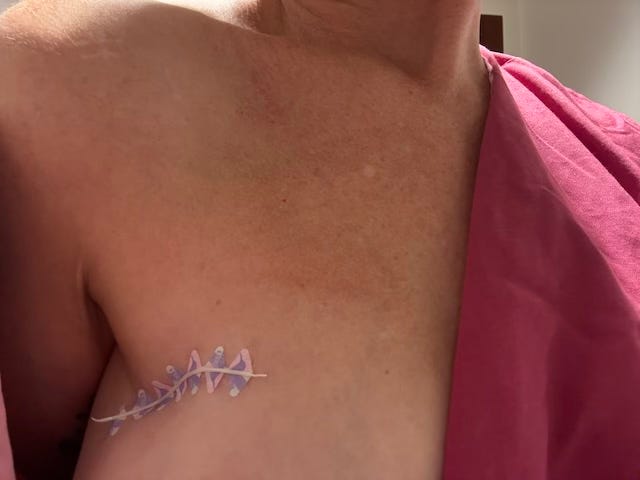
Ultimately it was confirmed via the lumpectomy that I had two types of breast cancer - lobular and ductal, both at stage 1a, which is as good as it can get in the world of cancer, because it means it has not spread anywhere at all. Unfortunately the cell type was quite aggressive, so in addition to the TWO lumpectomies (you can read about my medical error with the first one here), I also had to complete 3 months of chemotherapy and 6 weeks of radiation. I endured doctors with terrible bedside manner who made me cry, appointments in equipment storage rooms, dozens of Covid tests (the deep, back-of-the-throat kind from the beginning of the pandemic), debilitating bone pain, nausea and vomiting, losing the lining of my mouth, losing my hair, and more crying and sleepless nights than I can remember.
But. I also found wonderful and deeply empathetic doctors, ate a lot of ice cream, caught up on every TV show and movie that were ever on my list, had a head-shaving house party in my bathroom with my husband and kids, painted my bald head with the blue Avatar arrow, took lovely pain killers, and went on so many walks that I learned where all of my favorite flowers and trees are in my neighborhood. I’ve learned through having two cancers with difficult treatments that there are, in fact, sometimes silver linings to bad things. If it had not been for my first cancer, I would not have had the courage to leave a first marriage and seek out my true soul mate, I would not have had my beautiful and loving children, I would still be stuck in a career that made me unhappy. If not for the second cancer, I would not be writing and podcasting about healthcare and helping others to learn how to empower themselves as patients.
I’m now 5 years out from the breast cancer, though I still do not consider myself a cancer “survivor”, knowing that breast cancer recurrence rates are higher than those of many other cancers. I still think about it almost every day at some point. It’s as if it lives just under the skin, impossible to shake. It’s another odd silver lining of cancer, this priority reshuffling, which allows me to focus more on the joys of life.
I hope that you found this 4-part series on what it really feels like to find out that you have cancer enlightening or heartening. This was my experience; for others it feels vastly different. My goal in sharing these months of my life with you is to raise awareness of what someone that you know may be going through, or if it’s you, to let you know that you are not alone.
A lot of people ask me what they should do when one of their friends or family member is diagnosed with cancer. Call or don’t call? Visit or don’t visit? My answer is always: it’s never wrong to reach out, though it’s best to give that person lots of space to reply or not, in case they don’t feel like it. Maybe they’re sitting in the bathtub getting their head shaved by their children listening to dance music and can’t come to the phone right now.
Follow me for more writing and podcasting on healthcare from both sides of the bed at www.drpatientpodcast.com


