What It's Like to Find Out You Have Cancer, Part 2
This is a continuation of a short series, a firsthand account for anyone who wants to understand what this is like. In part 1, I told the story of my mammogram in the Fall of 2020 where I received bad news in the kleenex-box-room that malignancy was suspected. Part 2 covers the wait and the biopsy.
_____________
Part 2: The Wait and the Biopsy
I left off in Part 1 with having received a phone call from the laughing woman who told me that I would now only have to wait 11 days to find out if I have cancer, instead of 13. The days seem to roll by on an endless loop of deep, unrelenting worry and complete denial, and it is exhausting. I cry when no one is around because I’m simultaneously trying to protect my family from my own fear, even though I’m sure that they have plenty of their own already. I try my best to maintain normalcy: cooking dinners, wiping down surfaces because of Covid, making cookies, reading books. I don’t think I actually read a word of any of them since I am constantly thinking about the impending news. It feels cruelly ironic to have to do laundry when there is likely cancer literally growing inside of me right now. It seems as if the world should stop and wait alongside me, but it does not. And normally, I’d say that this fear would eclipse everything else in life and make other things less important, but we’re also living through the scariest time of the pandemic, with one quarter of a million people already dead in this country alone. Needless to say that fear, anxiety, and general emotional discomfort is at an all time high.
Part of that is coming from the fact that I know from having terrible cancer in college that one day you’re about to go to the school football game and get loaded with friends, and a few days later you’re getting poked and scanned and are told that you have cancer and might only have a few weeks to live. it happened for me almost that quickly in 1990. So what I can’t get out of my head for the next 11 days is that as soon as I get that biopsy, our whole life would probably change, maybe for the worse for just a while, or maybe for the worse forever. I become obsessed with running through the potential outcomes. I lean towards assuming the worst – I think that it will be easier to be ready for that and be pleasantly relieved, rather than hoping for the best and running into a reality brick wall. So this means that I start getting deeply emotional. I begin imagining what my family’s life will be like without me – specifics like who will keep teaching my daughter how to bake? Who will replace me as my son’s emotional safety net? Who will cuddle with my husband at night and listen to his extensive thoughts on life that he likes to bring up just as I’m dozing off? I have trouble sleeping, I lose my appetite, though I also keep drowning my sorrows in ice cream, and I cry. A lot.
Finally it’s the biopsy day and I head back to the beautiful building, the fancy furniture and the warm pink half-gown, though I don’t notice any of it today. This time we walk all the way down a hallway that I haven’t seen before, and this makes me feel like I’m being relegated to the hall where the people who got bad news go. Because every other time I’ve ever been here, I stopped at the first or second hallway where all the regular women getting screening seem to go. The change of hallway serves to make me even more irrationally scared that it will be bad news. Also, this time I change into a blue gown instead of the pink 3 arm hole gown from the mammogram, which just makes it all feel even more serious. When emotions are so heightened and raw, the little things feel big. I only wait a few minutes before a nurse, then a medical fellow -that’s a doctor that’s at the very end of their training - come in to review the procedure, risks and consent form.
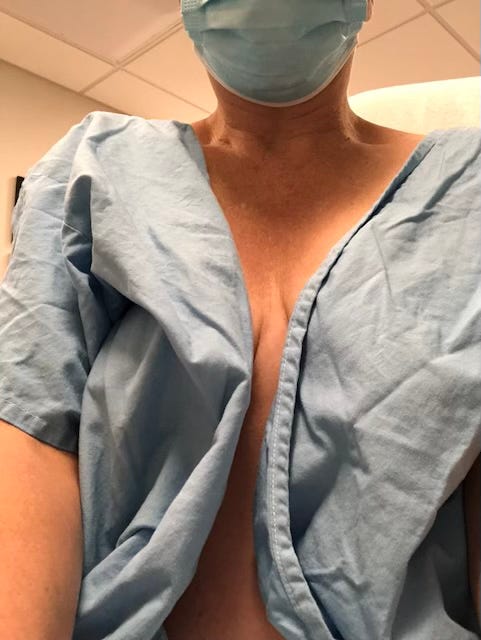
They bring me into a room that is surprisingly cluttered– counters, chairs, equipment, a procedure table, and many red-topped containers awaiting their biopsied samples (the red seems a very alarmist color). They have me lay face down on the table that is one corner of the room. They explain that there is a hole in the middle of the table for my breast to go through, and that they will be performing the biopsy basically under the table, which causes all sorts of hilarious scenarios in my head of people on their knees crawling around down there. But I’m too scared to laugh out loud. Humor fades fast as I pull off my gown, lay down and turn my head, as instructed, away from the rest of the room. So I’m now positioned in the corner staring at a white wall that is about 2 feet in front of my face. There are no calm colors painted in these back rooms. Everyone is behind me and doing things, but I can’t see them so I just have to listen and imagine. The partial sensory deprivation is unsettling to say the least, and makes me feel even more helpless. The nurse is pretty good at communicating what I’m hearing, though there are long pauses where I’m just left to wonder what’s happening back there. Then I’m suddenly aware that my earring-back is digging into my skin so hard that I have to stop everyone so that I can sit up and remove it.
I lay back down, and they slightly tilt the table so that my feet are over the level of my heart. This is causing tons of blood to rush to my heart and face and I’m breathing hard and fast. No one notices, though they can’t see my face because I’m looking at the wall, and my heart is pounding so hard and I suddenly realize that I don’t know if anyone here knows that I have heart failure. It should be right there in my chart, but I’m not sure if any of them really looked at it. This part I suffer in silence because it all already feels like too much, and I don’t want to add any complexity to it.
They’re finally ready to get things set up, and the nurse reaches for my breast from under the table, through the hole. The way that they roughly handle such a sensitive part of the body makes me feel like I’m not even human for a few minutes. I know that they have to get it positioned just right in between the imaging plates so that the biopsy is right on target, but that doesn’t make it feel any better. Soon everything is in the right place, and they basically lock and load the thick plastic plates holding my breast in a very specific position. The door opens and I hear voices, though I don’t know who it is since I’m looking at a wall. Also, neither of the two say hello or even address me. I recognize the Fellow’s voice, and guess that he is talking to the attending, the doctor in charge. It feels as if because my face is out of sight, that my entire being is out of sight from them.
They apply a cool cleaning solution, and the lidocaine is sharp, though hurts a lot less than I thought it would. I keep wondering what gauge needle they’re using, if only to focus on anything else except what’s actually happening. Within a few seconds of the lidocaine going in, my smart watch starts ringing on my wrist, as in a phone call coming in. I ignore it of course, but I instinctively know that it’s one of my kids asking about something. Of course they have this timing. The fellow is talking me through what is happening. I assume he’s the one doing it, though no one has actually said that and I can’t see, so I don’t actually know. More helplessness. There is a pulling sensation and a popping sound when the actual biopsy is taken that they had warned me about ahead of time. After all of this, I know that they are inserting a tiny titanium “marker” at the biopsy site, in case it’s bad news and they need to go back in – a titanium boob bookmark, if you will. After it is completed, they take a few more images and I’m once again left wondering how much radiation I’ve had just from the last two weeks in this building.
When it’s over, I’m handed a laughably plain brown paper lunch bag filled with supplies like small round ice packs that will fit inside of a bra cup, some gauze and bandaids in case of bleeding. I walk out in a daze , bra filled with ice packs, and resume my worried wait. I again cannot believe how much waiting is involved in the process. And at this point, the loneliness really sets in. It’s not that I am actually alone. My family is constantly checking on me, but the problem is that this is one of those life experiences that you just can’t understand unless you are the person going through it. Not one of them can understand the feelings that I’m having, despite my best intentions to communicate them. Because at the end of the day, it’s just me putting on the pink gown. It’s just me jumping when the phone rings. It’s just me raging at the laundry machine. It’s just me in the biopsy room living through the pain and fear. It’s just me (I think) laying awake at night running through the death scenarios. It’s just me.
Stay tuned for Part 3, The News and the Aftermath


